Metro State University opens and closes its production of "Animal Farm"
By Bronwyn Kmiecik
On October 24, Metro State University lowered the curtain on their production of “Animal Farm,” written by George Orwell and adapted by Ian Wooldridge. The production was an impressive display of collaboration and storytelling, with a diverse cast of students from a range of different state schools.
Theresa Mock, the director of Metro State’s production of “Animal Farm” with a master's of fine arts, explained that widening the casting pool provided the opportunity to choose a play more relevant to the current social and political climate. “[‘Animal Farm’] asks us to pay attention to how power operates, who benefits from it, and whose labor makes it possible… Through propaganda, the manipulation of language, and the rewriting of history, those in power can convince people to accept conditions that once would have been unthinkable,” Mock said, elaborating on how “Animal Farm” continues to be relevant 80 years after its publication. “I also wanted this production to highlight the link between the rise of totalitarianism and widening economic disparity we are facing today in the US,” Mock continued, highlighting how Metro State’s production fit into the original messaging of Orwell’s story.
“Animal Farm” is a difficult play to perform accurately; its heavy themes and messaging are made more challenging to convey because the cast consists only of animals. In particular, at the end of the play, the pigs who have been oppressing the animals of Animal Farm begin walking on two legs, making them indistinguishable from the humans the animals once so violently opposed. “The ensemble of actors portray the animals at about 25% animal and 75% human throughout most of the play, so they are already transposing the 4-legged animals to two legs for their ease and relatability for the audience. The tricky thing to then figure out about the ending is how to treat the reveal so the audience can understand they are now, in fact, on 2 legs and weren't before,” Mock said, explaining the most challenging part of the show. The reveal was handled well during Metro State’s production; the pigs switched from wearing work boots like the rest of the animals to platformed boots and heels, raising them above their fellow animals, who also got down on all fours for the final scene, cementing how uncanny it was that the pigs were upright.
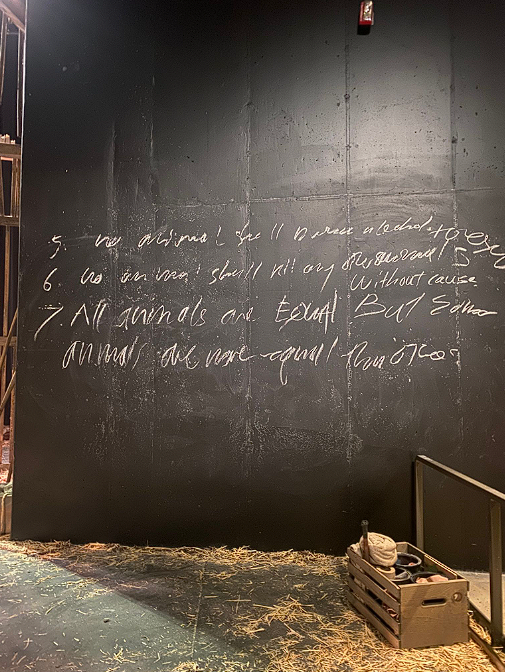
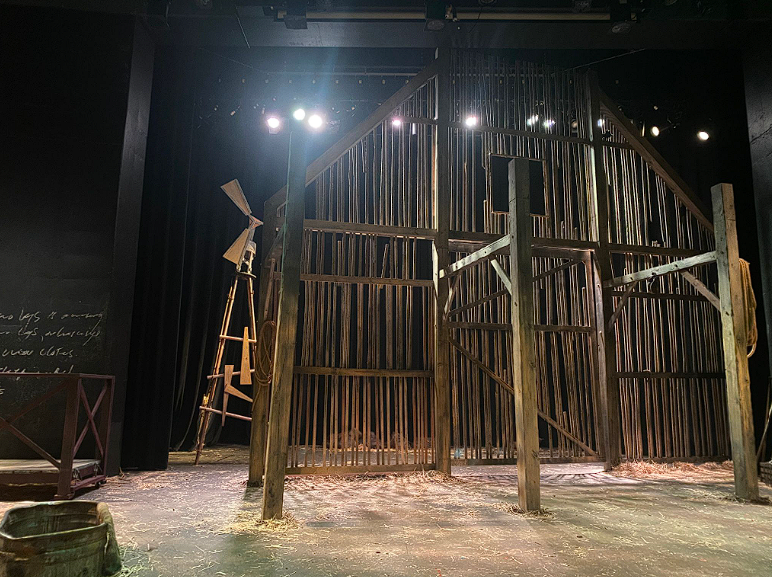
From a technical standpoint, the production was impressive. The main feature of the set was a twenty-foot-tall barn that loomed over the stage, making the actors seem much smaller by comparison and therefore more animal-like. “Both the set designer, Kurt Gough, and myself serendipitously had the same vision of a slatted barn wall with light filtering through the cracks. The idea is that certain events of the story, moments of violence, activities of the humans, anything surreptitious, happens upstage of the barn wall and is somewhat fragmented and obscured. We can't fully see what is happening, so these events are then easily reshaped and an alternative truth is presented through propaganda,” Mock explained. The set also featured parts of a windmill that could be assembled on stage and tipped over to simulate being destroyed by a storm, which was a poignant display of destruction and a remarkable demonstration of durable set design. The sound design furthered the immersion of the experience: using ambient sounds like crickets chirping to fill the background, while using oppressive humming during intense scenes to weigh down the audience and solidify the significance of the scene. The behind-the-scenes details made the play an interesting and impactful experience, and it was clear that a lot of effort and care went into this interpretation of Orwell’s “Animal Farm.”