Boots on the Ground: Artist Alexandra Beaumont's work reminds us of the importance of collective movement
By Sinead Quinn
New art on campus debuted at the beginning of the semester with the Catherine G. Murphy Gallery hosting two separate exhibitions. Both textile artists in practice, Alexandra Beaumont and Marjorie Fedyszyn are exhibiting “Boots on the Ground” and “No Where, Now Here” respectively. I had the opportunity to speak with Beaumont, a South Carolina-born dancer and textile artist based in Minneapolis, about her dynamic exhibition, which centers on collective movement and the presence of federal law enforcement and the military in the U.S. Beaumont’s exhibition is housed in the West Gallery.
Much of Beaumont’s work concerns the relationship between textile and movement. She explained that in the past, she has focused on “dancing together as a route to solidarity through shared joy.” Here, however, she explores how dance is used “in a direct way as a tool of community building and protest.”
“I’d just started dancing with Gotta Dance [a Soul Line Dance Collective hosted at Jimmy Lee Recreation Center] when I witnessed Kalpulli Yaocenoxtli [a Mexica-Nahua cultural dance group] at a protest for a local activist who’d been wrongfully charged.” She continued, “Each group danced in lines, rows, in power and with a deep sense of connectedness…I envisioned an army of dancers facing off against forces of oppression. The rows of rectangles [visible in the works] come from that image, as well as a notion...of inhabiting a place.” Where her previous works centered around individuals, Beaumont “wanted this body of work to honor collective power.”
The title of the exhibition, “Boots on the Ground,” carries both militaristic implications but is also the name of a Black line dance. I asked Beaumont how she defined the relationships between protest, parade (another theme in her work) and dance, and how these practices influence the direction of her artwork. Beaumont shared, “The distinctions, thankfully, are not clear! I believe in the inherent power of moving together, whether that be marching down the street holding signs or dancing down the street in costume.”
She explained the importance of taking up public space. In order to coordinate people to move together, “there is nothing like rhythm to synchronize a mass of bodies,” Beaumont emphasized. “In this way, dancing becomes a tool for organizing people corporeally, in the same way that singing together means breathing together,” making it “easier to fight together.”
I next asked Beaumont how, being a multidisciplinary artist, she goes about selecting mediums and tools for her work. She explained, “A fellow artist and mentor of mine, Shana Kaplow, gave me the prompt once to examine how an idea feels in my body. For example, is it tight or does it flow? Then it’s about how I want to make the viewer feel in their bodies.” She described the “intimate” relationship everyone has to cloth. She also noted that experimentation allows her to grow as an artist technically.
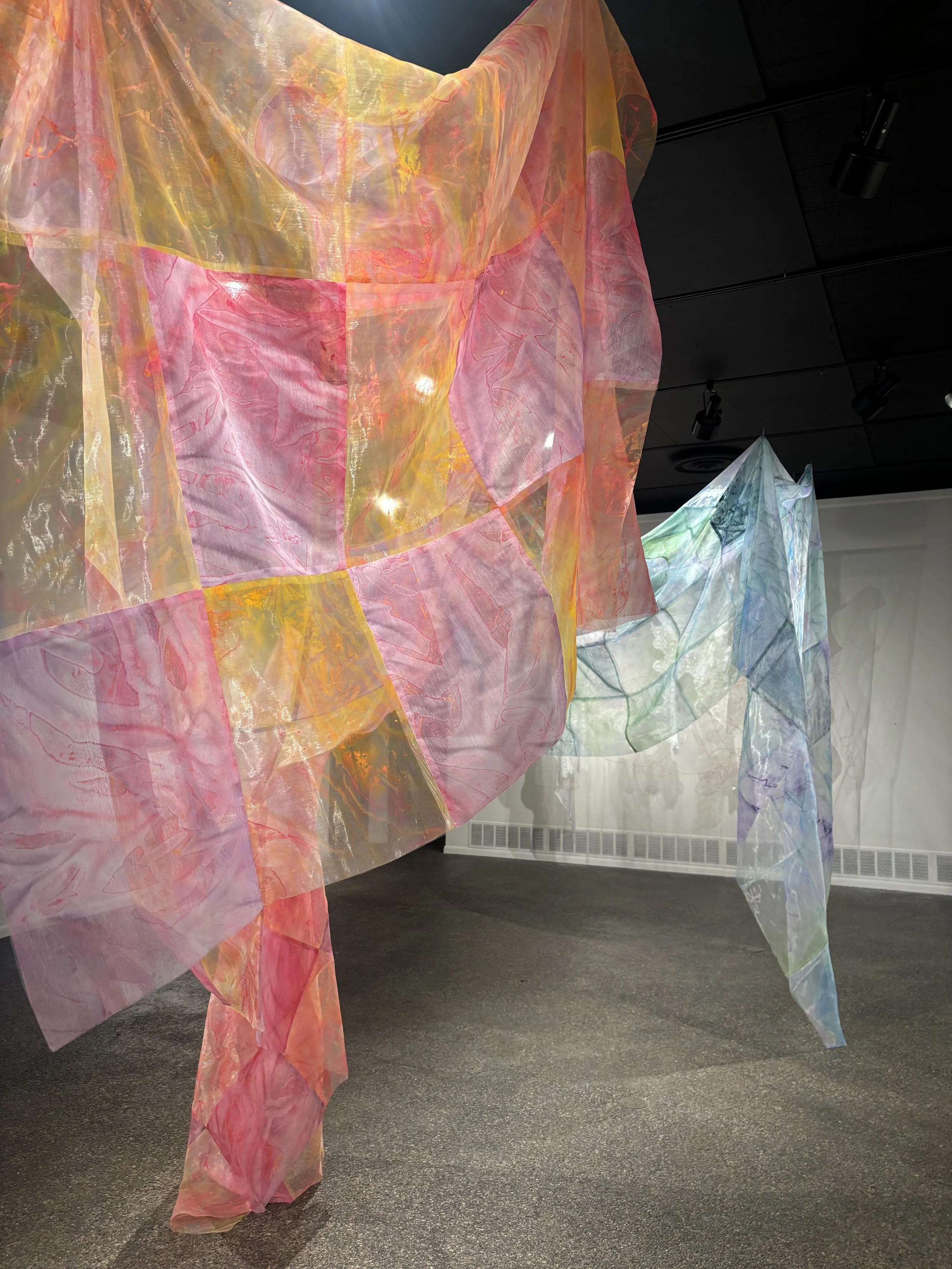
The exhibition itself takes advantage of color, drapery, and transparency in order to make a highly interactive exhibition. Upon my visit, I was struck by the way the arrangement of the exhibition engages the visitor in a dance of their own in and around the works, challenging them to consider the pieces from a variety of angles. I asked Beaumont how she selects colors and how the materials themselves (including a wide variety of textiles) influence her work. “The bright colors in this show pay homage to the Gotta Dance crew,” she explained. “They always wear colorful tie-dye shirts, so I wanted to bring in that sense of exuberance. The patterns in the cloth…blend a tie-dye look and camouflage,” in accordance with the show’s title.
At either end of the exhibit are white collages of dancers embroidered in red thread, which Beaumont explained also reference camouflage and “Kalpulli Yaocenoxtli’s red and white clothing.” The choice of sheer fabric, she explained, was because she was considering “space, landscape, light, fluidity, [and] movement…this dance army is as nimble as it is powerful.”
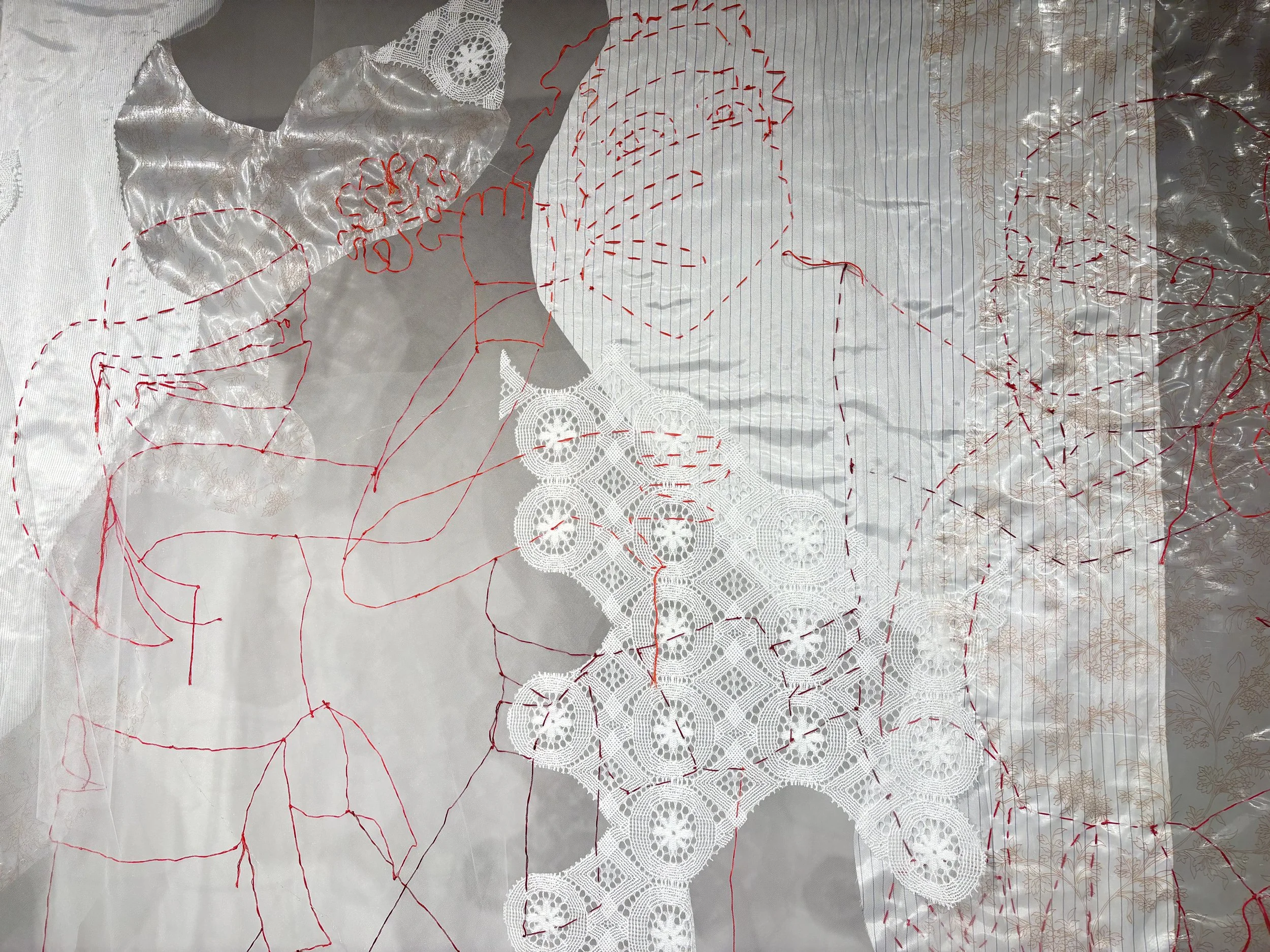
Dancers embroidered in red thread on white fabric.
Most of the works in the exhibition are paired. I asked Beaumont what led her to make complementary pieces. “An exhibition allows you to try out visual ideas over many pieces. So naturally they speak to each other,” she explained. “I also wanted to put these two dance groups – whom I have so much respect and gratitude for – in direct connection with each other, which you can see in the checkerboard wall pieces.”
I concluded the interview by asking Beaumont how she ended up in the Twin Cities. She explained that visits to Minneapolis were “the first time [she] felt [she] was in a city actually built for and around its residents.” Beaumont has been based in the Twin Cities since 2016. She added that she has been here for multiple transformative periods, and that the community has helped give her “the courage” to become an artist. “I’ve never been prouder to be from here than right now,” she added.
Beaumont’s work resonates deeply with the feelings many are experiencing as federal law enforcement and the military continue to occupy U.S. cities, notably Minneapolis. Her work is a reminder that there is beauty, order, community, and rhythm in collective organizing, and that the practice can help Minnesotans as we face grief and anxiety, while also being invigorated by hope and determination.
Beaumont’s work will be exhibited until February 28 at the Catherine G. Murphy Gallery. If you'd like to learn more about Beaumont, visit her website here. Dates for a reception for Boots on the Ground will be determined later in the semester, as the initial reception and artist talk were both cancelled due to the current ICE presence.