
What Ramadan Really Means: More Than Just Fasting
By: Amirah Idris
As the sun rises over St. Catherine University, some of us have already been awake for hours. While the smell of coffee drifts through campus hallways and breakfast conversations begin, we start our day without food or water. Yes, no water either. For nearly thirty days, during Ramadan, we fast from dawn until sunset, not as a diet or a trend, but as an act of worship, discipline, and reflection. Ramadan is often simplified as “the month Muslims do not eat,” but for us, it is far more than hunger. It is a spiritual reset, a quiet act of devotion, and a reminder that faith is not just something we claim. It is something we practice daily with intention.
The reason fasting was prescribed is directly stated in the Qur’an: “O you who believe, fasting has been prescribed for you as it was prescribed for those before you so that you may attain taqwa.” (Surah Al Baqarah, Ayah 183) “The month of Ramadan is the month in which the Qur’an was revealed as guidance for mankind, and clear proofs of guidance and criterion…” (Surah Al Baqarah, Ayah 185)
The word "taqwa” is often translated as God consciousness, meaning an awareness of Allah, the Arabic word for God in Islam. It refers to a state in which a believer moves through the world mindful that Allah (SWT) sees and knows all things. Fasting, then, is not simply about hunger. It is about choosing discipline out of devotion.
The verses from our holy book in Islam, Surah Al Baqarah 185, further remind believers that Ramadan is the month in which the Qur’an was revealed as guidance for humanity. This connects fasting to something greater than physical endurance. It ties the month to reflection, scripture, and moral clarity. Muslims increase their prayer, charity, and reading of the Qur’an during this time not out of routine, but out of a desire to realign themselves with that guidance.

While fasting can cultivate empathy for those who experience hunger daily, scholars consistently emphasize that its primary purpose is spiritual refinement. Ramadan humbles the body, but it is meant to elevate the heart.
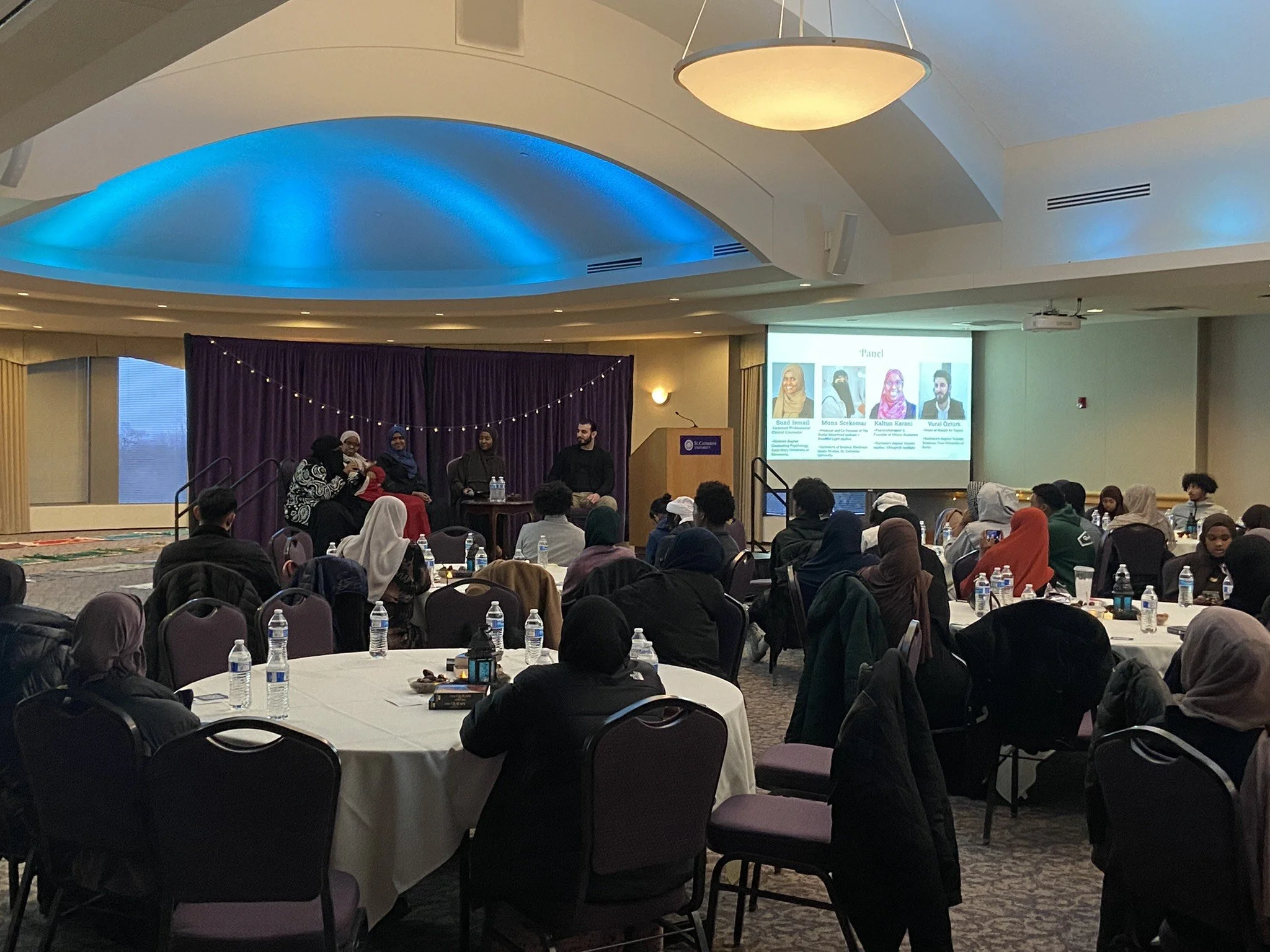
That deeper meaning was reflected not only in personal acts of worship this month, but also in community. At St. Catherine University, an interfaith Iftar brought students of different faith backgrounds together to learn about Ramadan and share in the experience of breaking the fast at sunset. For many attendees, it was their first time witnessing what Ramadan looks like beyond headlines or assumptions. For Muslim students, it was an opportunity to explain that fasting is not rooted in deprivation, but in devotion.
So you see, it is not us just starving for a month. It is so much more for us spiritually and emotionally.
If you would like to look at these verses in person, we have copies of our holy book, the Qur'an, located in the prayer room on the second floor of the CDC next to Caribou. It is written in the Arabic language; however, English translation is also included. If you choose to visit, on behalf of the Muslim community, we kindly ask that you respect our prayer space. This includes no food or drinks in the prayer room, taking your shoes off once you enter the room and placing them on the shoe shelf provided, keeping your voice down, and being mindful of others who may be praying. Please do not walk in front of someone who is praying, as they are performing an act of worship. Most importantly, we ask that you approach the space without judgment, as we should all respect one another’s religion.
If you have any other questions about our religion as Muslims, and it doesn’t have to be just related to Ramadan, it can be anything about Islam, feel free to email me at amidris029@stkate.edu or reach me at my phone number, 763-327-6691.