Neighbors express concern regarding proposal for new St. Kate’s entrance to Dew Drop Lot
By Sinead Quinn
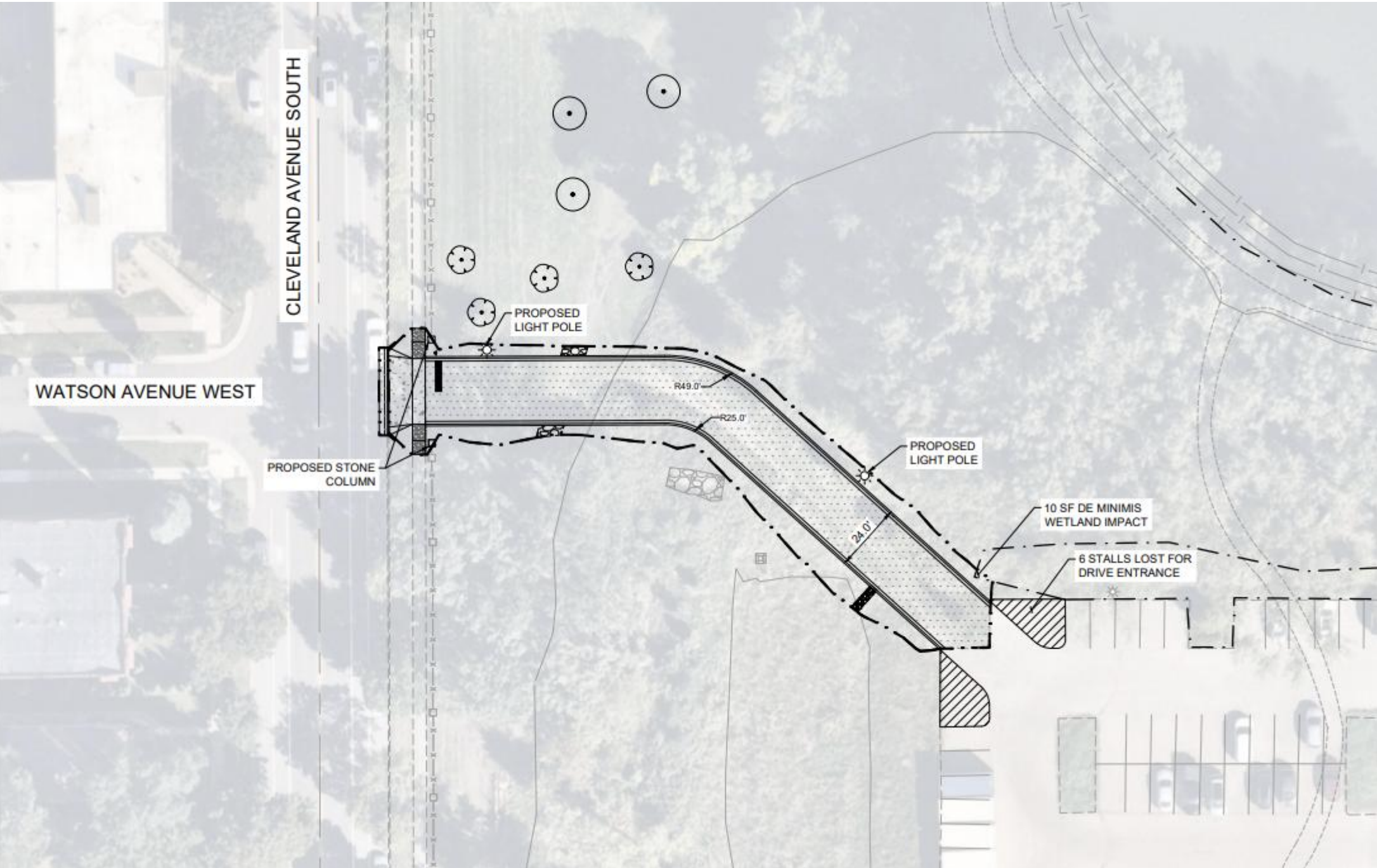
Earlier this spring, St. Kate’s approached the Highland District Council with a proposal for a new entrance to the campus at the intersection of Cleveland and Watson Avenues. Neighbors on Watson and surrounding blocks were notified of the application in late March via a flier distributed directly to residences by the HDC, inviting community members to an April 7th Zoom meeting to discuss the details of the proposition. The information on the flier was brief, expressing that the meeting would consider “the application from St Catherine’s University to the City of Saint Paul and Ramsey County for a new driveway entrance located on Cleveland Ave directly across from Watson Ave.” On the flier was a map of the proposed entrance. Those receiving the flier were invited to submit questions ahead of time to the HDC.
Representing St. Kate’s at the meeting were Michael Hara, Senior Director of Purchasing, Contracts and University Services, and Justin Lester, the Kimley Horn Design Consultant for St. Kate’s. St. Kate’s rationale for the project is that it will improve “internal circulation of students seeking parking” and provide “faster access for emergency vehicles to certain dormitories in the west end.” It was explained during the meeting that Kimley Horn had conducted a study three years ago to evaluate the usage of campus parking lots. It found that the Dew Drop Lot was only reaching 50% capacity. The new driveway, St. Kate’s argues, will address that disparity.
One meeting attendee questioned if the university was “confident [that] use of the lot would increase if a more direct road were added,” or if the capacity issue is more closely linked to the Dew Drop Lot’s lack of proximity to buildings on campus.
More than a dozen neighbors joined the meeting, and thirteen others communicated their questions and concerns to Kathy Carruth, Executive Director, via email. Community members expressed numerous concerns about the safety, utility, and other detriments of the entrance. These concerns included pedestrian safety, traffic congestion on Cleveland Avenue, traffic augmentation on Watson, and impact on local and campus wildlife (including trees). Multiple neighbors inquired why the University could not reconfigure the current “wishbone” entrance to serve the Dew Drop Lot. According to one-on-one correspondence with HDC Representative Tim Morehead, no alternative locations have been officially considered for the project.
Other community members criticized the University for not taking environmental concerns seriously, even though Lester estimated that “nearly 10 mature trees” would have to come down. Lester did argue, however, that alternative routes suggested by neighbors during the meeting (such as the utility road between Hartford and Bayard) would negatively impact more wetland. In response, two neighbors expressed discontentment that in their opinion, St. Kate’s had not scrutinized and considered the loss of wetlands more closely when the Dew Drop Lot was constructed back in 2018.
Concern about pedestrian safety and increased traffic was expressed by several neighbors, both in letters to the HDC and in the meeting itself. According to one-on-one correspondence with Morehead, “the HDC forwards all local safety concerns and the HDC recommendations of safety to the City of St. Paul based on several inputs.” Watson residents in particular expressed concern about children on the street who play in front yards and need to cross the street. According to neighbors, pedestrian safety on that stretch of Cleveland itself is already a major concern, with no marked crosswalks, low visibility from those turning onto Cleveland from cross-streets, and as a result of parking on both sides of the street.
One neighbor remarked that it was “nearly impossible” to turn onto Cleveland from Watson. Multiple neighbors suggested safety measures such as making the entrance right-turn only, adding an island, or adding a marked crosswalk. St. Kate’s stated that they would be conducting a traffic study, but did not give insight into how the numbers would be evaluated. However, Morehead has established that neighbors will have access to the traffic study data. Neighbors expressed concern over whether the traffic study would actually inform the University and HDC’s decision, or whether it would merely be a formality.
Some of the community members also questioned the legitimacy of the claim that the entrance would improve access for emergency vehicles. One neighbor questioned if large emergency vehicles would even be able to make a right turn into the driveway. Another suggested the city conduct a time study of access to the dorms by emergency responders from the lot.
Towards the end of the meeting, multiple neighbors expressed that they did not find the University’s answers satisfactory. One remarked, “St. Kate’s needs to go back to the drawing board and provide at least 3 proposals. This plan does not seem well thought through.”
In personal correspondence, Morehead explained that if the project goes through, its success will be evaluated according to whether it “[follows] all government zoning rules and is approved by [government] agencies” and “benefits the Highland Community.” Morehead explained that the “impact of the construction on the local neighborhood” is also reviewed. He added that the construction “will definitely impair the traffic on the street” because it will include curbing. Morehead emphasized, “the City of St. Paul and Ramsey County will control the approval of this project to meet all city and county guidelines, zoning and laws.”